
With the investment in another Leistritz turbine machine, the company Lock Antriebstechnik in Ertingen pursued the goal of faster and easier retrofitting in the future while simultaneously building up unmanned production. However, enormous material fluctuations frequently led to costly tool breakage. Therefore, in 2022, the company invested in the UT-Tm® tool and process monitoring system from UTTec. Since then, tool life has nearly quadrupled, and quality and productivity now meet current demands.
The company already had a Leistritz whirling machine. Based on its consistently positive experience, Lock Antriebstechnik invested in another Leistritz whirling machine, the LWN 120, in 2017. In the production of worms for gearboxes, the goal of this investment was to combine the advantages of whirl turning—such as efficient dry machining and very high surface quality—with faster setup times and unmanned production (loading via robots). This goal appeared to have been achieved in the initial phase. However, when machining certain modules, the tool plates repeatedly broke. Tool life decreased dramatically at that time. Armin Schirmer, Head of Gear Component Manufacturing at Lock Antriebstechnik, comments: „On the one hand, such a breakage is caused by wear. In our case, however, it was mostly due to the tough and highly variable material. The cutting edge becomes clogged, and a built-up edge forms. The pressure then becomes too great, and the insert breaks. That’s why, together with Leistritz, we tested coatings, conducted material analyses, modified collets, tried everything possible—but we didn’t reach a solution. Our hypothesis was that the material and the cutting edge simply weren’t compatible.“ An even bigger problem, however, was that when a tool broke, machine components such as the spindle, axes, etc., were also displaced and had to be realigned. This was a costly process. That’s why Leistritz developed a system in which a probe with its own axis stored a master profile in the control system, scanned the component, and issued a corresponding message to either continue processing or abort the operation. The problem is that a built-up edge isn’t a form of normal wear and tear. Consequently, the team in Ertingen began taking measurements after every few screws and replacing the tool plates early as a precautionary measure. While this resulted in a longer service life, the problem of unmanned production at night and the enormous tooling costs persisted.
With optimized sensors and corresponding software to the goal
Therefore, Leistritz tested tool monitoring systems from various manufacturers. However, for Patrick Schuka, Sales Manager for Machine Tools at Leistritz, this was less than satisfactory: „Many systems measured power consumption, and by the time a breakage occurred, it was too late. This means the systems weren't sensitive enough, and the results were therefore not convincing. That's why we eventually stopped these tests, as we didn't want to pass the risk onto our customers.“ This changed through the collaboration with UTTec. After intensive trials with Leistritz's technology department, UTTec was convinced that these problems could not be solved with conventional standard monitoring. Numerous tests and analyses followed, leading to the realization that increasing the cutting parameters resulted in very fine, almost powder-like chips. For Uwe Schröter, Managing Director at UTTec, this was the starting point for further development: „These results showed us where we needed to go in terms of analysis before the plate break functions, but has also already amortized by 70 percent. And particularly pleasing for Jonas Zoll, the machine operator, the system is relatively easy to understand: „Of course, you have to spend some time with it until every program fits a product series. you also have to readjust if different cutting parameters or tools are used. But that's really not difficult. Our showcase discipline, for example, is a certain module with corresponding quantities. Once the system is set up, you can run it without any problems.“ Independently, the UT-Tm® system includes wear monitoring. This also optimizes the service life of the tool inserts. While this has already been done in Ertingen, the safety that the system recognizes early on when there is imminent danger is much more important to those responsible. And because this is the case, what was planned with the investment in the LWN 120 can now also be realized at Lock Antriebstechnik: The machine starts with a pallet of workpieces shortly before the end of the shift and manufactures unmanned at night, and now also during the day. In addition, the service life of the tools has significantly increased, which of course also leads to a considerable reduction in tool costs.
Lock Drive Technology in Focus
The internationally leading company for drive technology in agriculture operates in various sectors. In addition to producing and distributing drive elements for ventilation and shading of greenhouses and animal housing, Lock impresses with solutions for optimal building climate, environmental management, and Smart Farming. The company also stands out for its innovative and sustainable approaches, as well as close collaboration with agricultural research institutions across Europe.
Lock was recognized as one of the best employers in the «Germany's Best Employers» competition in 2020 and 2022 by Great Place to Work®.
By the way
Turbomachinery is a niche market. That is why Leistritz places great importance on customer satisfaction and is naturally interested in continuous development. The UT-Tm® system is adaptable and can therefore be retrofitted to all Leistritz machines.
Interesting side notes
Due to initial skepticism from the management at Lock Antriebstechnik, Leistritz initially offered the UT-Tm® system for testing. This means that if it hadn't worked, Leistritz would have taken it back. That didn't happen; the system has since paid for itself by 70 percent.
With the investment in another Leistritz turbine machine, the company Lock Antriebstechnik in Ertingen pursued the goal of faster and easier retrofitting in the future while simultaneously building up unmanned production. However, enormous material fluctuations frequently led to costly tool breakage. Therefore, in 2022, the company invested in the UT-Tm® tool and process monitoring system from UTTec. Since then, tool life has nearly quadrupled, and quality and productivity now meet current demands.
Lock Antriebstechnik already had a Leistritz turbine machine. Based on consistently positive experiences, the company invested in another Leistritz turbine machine, the LWN 120, in 2017. With this investment, they wanted to combine the advantages of whirling, such as efficient dry machining and very high surface quality, with faster changeovers and unmanned production (loading via robot) in the manufacturing of screw shafts for gearboxes. This goal initially seemed to have been achieved. However, during the machining of certain modules, tool inserts kept breaking. Tool life decreased dramatically during this period. Armin Schirmer, Head of Gear Part Manufacturing at Lock Antriebstechnik, comments: „Such a break is partly due to wear. With
However, for us, it was mostly the tough and very different material. The cutting edge lubricates and a built-up edge forms. The pressure then becomes too great, and the plate breaks. Therefore, in collaboration with Leistritz, we tested coatings, conducted material analyses, changed collets, and tried everything possible, but without achieving any results. Our assumption then was that the material and the cutting edge simply did not match. An even bigger problem, however, was that with a tool breakage, machine components such as the spindle, axes, etc. were also displaced and had to be realigned. A.
With optimized sensors and corresponding software to the goal
Therefore, Leistritz tested tool monitoring systems from various manufacturers. However, for Patrick Schuka, Sales Manager for Machine Tools at Leistritz, this was less than satisfactory: „Many systems measured power consumption, and by the time a breakage occurred, it was too late. This means the systems weren't sensitive enough, and the results were therefore not convincing. That's why we eventually stopped these tests, as we didn't want to pass the risk onto our customers.“ This changed through the collaboration with UTTec. After intensive trials with Leistritz's technology department, UTTec was convinced that these problems could not be solved with conventional standard monitoring. Numerous tests and analyses followed, leading to the realization that increasing the cutting parameters resulted in very fine, almost powder-like chips. For Uwe Schröter, Managing Director at UTTec, this was the starting point for further development: „These results showed us where we needed to go in terms of analysis before the plate break functions, but has also already amortized by 70 percent. And particularly pleasing for Jonas Zoll, the machine operator, the system is relatively easy to understand: „Of course, you have to spend some time with it until every program fits a product series. you also have to readjust if different cutting parameters or tools are used. But that's really not difficult. Our showcase discipline, for example, is a certain module with corresponding quantities. Once the system is set up, you can run it without any problems.“ Independently, the UT-Tm® system includes wear monitoring. This also optimizes the service life of the tool inserts. While this has already been done in Ertingen, the safety that the system recognizes early on when there is imminent danger is much more important to those responsible. And because this is the case, what was planned with the investment in the LWN 120 can now also be realized at Lock Antriebstechnik: The machine starts with a pallet of workpieces shortly before the end of the shift and manufactures unmanned at night, and now also during the day. In addition, the service life of the tools has significantly increased, which of course also leads to a considerable reduction in tool costs.
Lock Drive Technology in Focus
The internationally leading company for drive technology in agriculture operates in various sectors. In addition to producing and distributing drive elements for ventilation and shading of greenhouses and animal housing, Lock impresses with solutions for optimal building climate, environmental management, and Smart Farming. The company also stands out for its innovative and sustainable approaches, as well as close collaboration with agricultural research institutions across Europe.
Lock was recognized as one of the best employers in the «Germany's Best Employers» competition in 2020 and 2022 by Great Place to Work®.
By the way
Turbomachinery is a niche market. That is why Leistritz places great importance on customer satisfaction and is naturally interested in continuous development. The UT-Tm® system is adaptable and can therefore be retrofitted to all Leistritz machines.
Interesting side notes
Due to initial skepticism from the management at Lock Antriebstechnik, Leistritz initially offered the UT-Tm® system for testing. This means that if it hadn't worked, Leistritz would have taken it back. That didn't happen; the system has since paid for itself by 70 percent.
Contact
Lock Drive Technology GmbH
Mr. Armin Schirmer
D-88521 Ertingen
Phone: +49 7371/9508-430
www.lockdrives.com
UTTec GmbH & Co KG
D-71364 Winnenden
Tel. +49 (0) 7195 – 9791-100
www.uttec.de
Leistritz Production Technology GmbH
Mr. Patrick Schuka
D-92714 Pleystein
Tel. +49 9654/89-403
www.leistritz.com
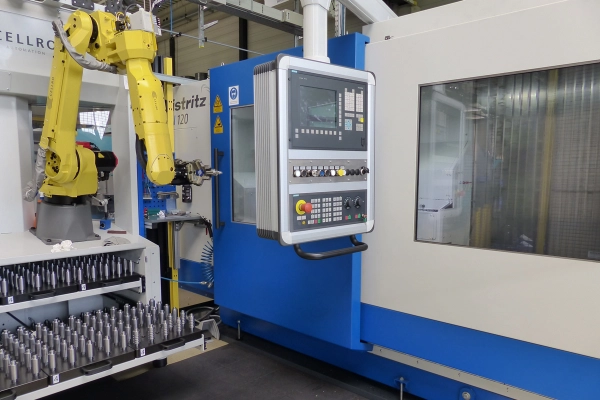
With the Leistritz LWN 120 spinning machine, the aim was to combine the advantages of spinning with faster changeovers and unmanned manufacturing.
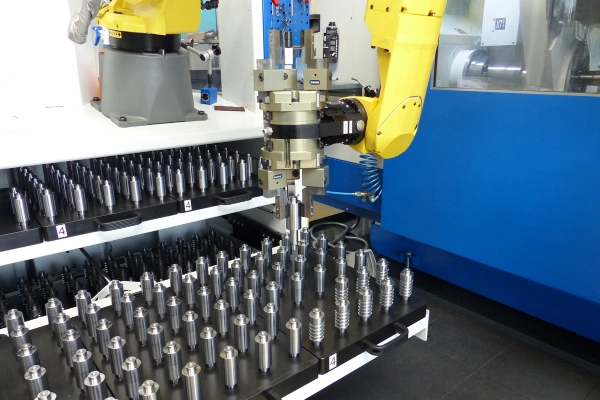
Shortly before the end of the shift, the machine starts up and runs unmanned at night. In the meantime, the company has also started running the machine automatically during the day.
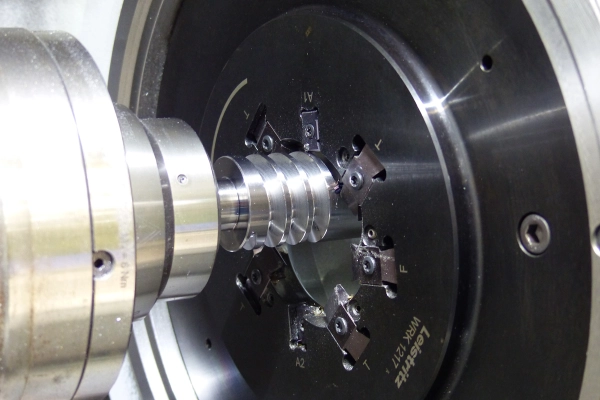
The danger with materials of different toughness is that the cutting edge can gum up and form a built-up edge.
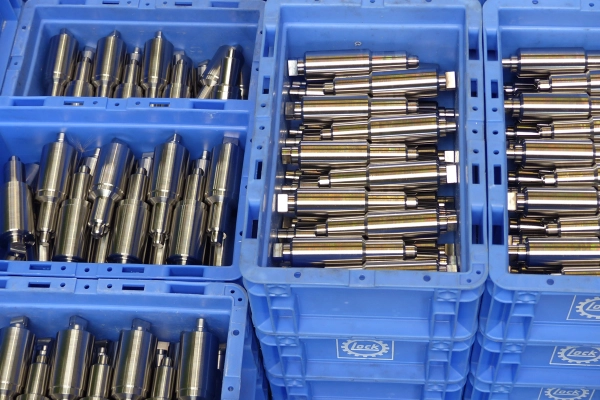
The flagship discipline of Lock Antriebstechnik is a specific module with corresponding quantities.
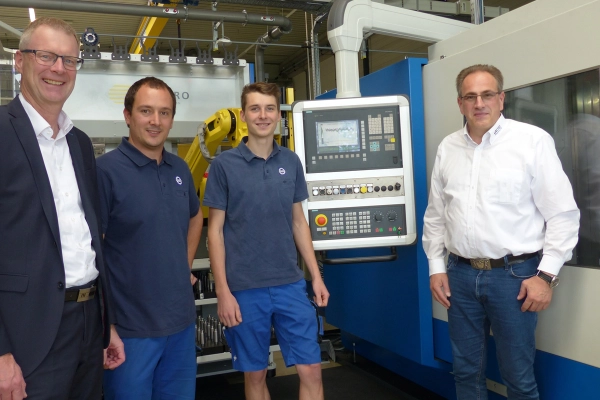
Patrick Schuka, Armin Schirmer, Jonas Zoll, and Uwe Schröter (from left to right): „The important thing is that the system recognizes early on when there is imminent danger. With the quadrupling of the service life, fully automated production is no longer a problem.“
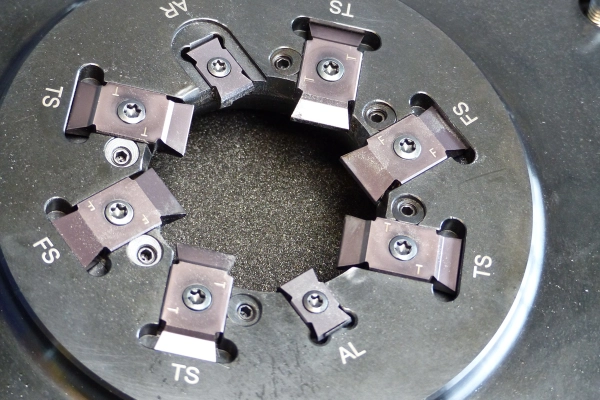
Before the use of the UT-Tm® system, the tool plates were changed very early as a precaution, which naturally led to enormous tooling costs.
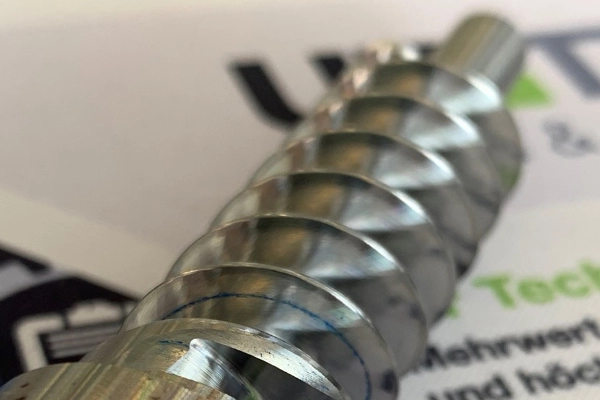
Traces of a built-up edge are clearly visible on a test component.
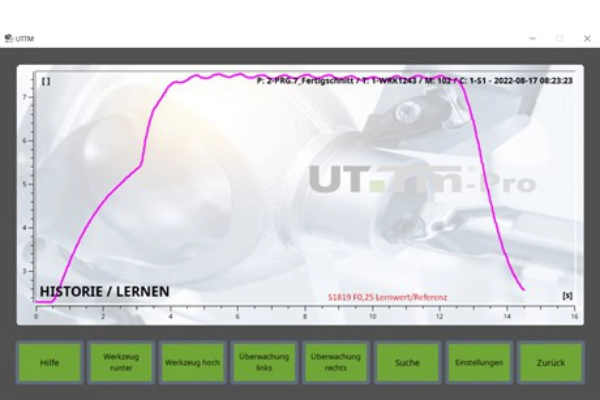
The system is relatively easy to understand and also has an automatic learning function.
written with the kind support of


 English
  Deutsch
  Polski
  Italiano
  Français
  简体中文
简体中文